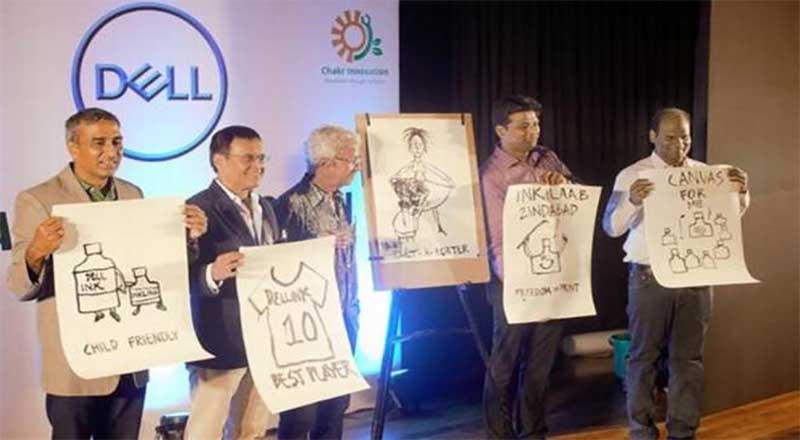
To promote sustainability and create awareness about air pollution Dell has partnered with the Chakr Innovation which converts diesel soot into ink (POINK) through their retro-fit emission control device for diesel generators
To promote sustainability and create awareness about air pollution Dell has partnered with the Chakr Innovation which converts diesel soot into ink (POINK) through their retro-fit emission control device for diesel generators.
The technology can capture over 90 per cent of the particulate matter emissions from the exhaust of diesel generators without causing any adverse impact on the diesel engine.
Speaking about the event, Rajeev Kapoor, India Vice President and CSR Champion, Dell said, “Environmental responsibility is much more than creating eco-friendly products. It’s about incorporating sustainability into every practice. Innovative thinking and eco-friendly designs are the first steps in minimizing the impact on the environment. We support inventions which solve larger problems and are glad to partner with Chakr innovation to address the issue of rising levels of air pollution in the city and initiate a positive dialogue around the issue.”
Adding to this, Kushagra Srivastava, CEO, Chakr Innovation said, “We aim to curb air pollution by recycling it. Our product, Chakr Shield helps reducing air pollution by converting diesel soot from generators into inks and paints which can be safely reused. We are proud to partner with Dell which not only promotes but also practices various sustainable methods across its functions. It’s encouraging to see that Dell has been using poink for packaging and printing products at its manufacturing facility in India. We hope to amplify the partnership to capture the air pollution at its source and create a beautiful and greener tomorrow for everyone around us.”
Two iconic brands, DIESEL and Coca-Cola have launched ‘The(Re)Collection’ — a beautifully crafted clothing collection partially made from recycled materials, including plastic bottles
Two iconic brands, DIESEL and Coca-Cola have launched ‘The(Re)Collection’ — a beautifully crafted clothing collection partially made from recycled materials, including plastic bottles.
In India, the (Re)Collection is exclusively available at 11 Diesel stores with a retail price starting from Rs 6,000 to Rs 25,000. Diesel India will also be showcasing the capsule collection as a pop-up in major cities.
The range includes recycled materials such as recycled PET derived from plastic bottles and recycled cotton, to create a fresh, modern interpretation of the Diesel casualwear aesthetic combined with Coca-Cola iconicity.
Creating beautiful fibres from plastic, this collaboration aims to raise awareness on the value of recycling with all pieces made with recycled PET fibres.
Commenting on the new partnership, Coca-Cola Company Vice President of Global Licensing & Retail Michelle Moorehead said: “Not only does The (Re)Collection generate awareness of the importance of recycling in a very approachable way – by showcasing beautiful fashions created from recycled materials – it’s also a collection that celebrates individuality.”
HCL’s Shiv Nadar has topped the list of givers for philanthropic acts, but the richest Indian Mukesh Ambani ranks third behind Azim Premji, who created headlines by announcing a USD 21 billion commitment to charity. The Edelgive
HCL’s Shiv Nadar has topped the list of givers for philanthropic acts, but the richest Indian Mukesh Ambani ranks third behind Azim Premji, who created headlines by announcing a USD 21 billion commitment to charity. The Edelgive Hurun India Philanthropy List 2019 has made this ranking.
Nadar and his family donated Rs 826 crore, while Premji gave Rs 453 crore and Ambani parted with Rs 402 crore, according to the list. Companies Act 2013 has made it mandatory for entities above a certain threshold to devote 2 per cent of their profit to Corporate Social Responsibility (CSR) projects.
Edelgive Foundation chief executive Vidya Shah said fear of being associated with causes like civil liberties, along with lack of measurability of the impact, are working as impediments for corporates from pledging more.
From 38 in 2018, the Indians who have donated more than Rs 5 crore for social causes, excluding religious donations, has touched 72 now. The overall philanthropic contributions also nearly doubled to Rs 4,391 crore, with nearly half of the contributions have come in individual donations, while the rest have come from companies.
There has been an uptick in the percentage of wealth that has been parted with by the rich families, shows the list, which assumes 10 per cent of net worth is held in cash,1.9 per cent given away now as against 1.5 per cent in 2018. Education continues to be the most favourite among the causes, followed by healthcare, while Infosys co-founder Nandan Nilekani, who along with wife Rohini who have spent Rs 346 crore, have chosen “societal platforms” for charities.
There is a tendency among Indians to give more as they grow older, as per the list, adding the average age of the giver is 64 years. However, as more exits happen, new age entrepreneurs are also getting more active on the giving side, Shah said, adding the Bansals of e-commerce major Flipkart are planning to start donating via a recently set up family office. Hurun managing director Anas Rahman Junaid explained that the list limits itself to the amount spent due to which Premji comes second. The Tatas are excluded as the list focuses on individuals.
A year-long volunteer program has been launched to beat plastic pollution at Sanjay Gandhi National Park, Borivali and beaches of Mumbai by leading beverage firm Coca-Cola India. Coca Cola India and AIESEC have teamed up with Afroz
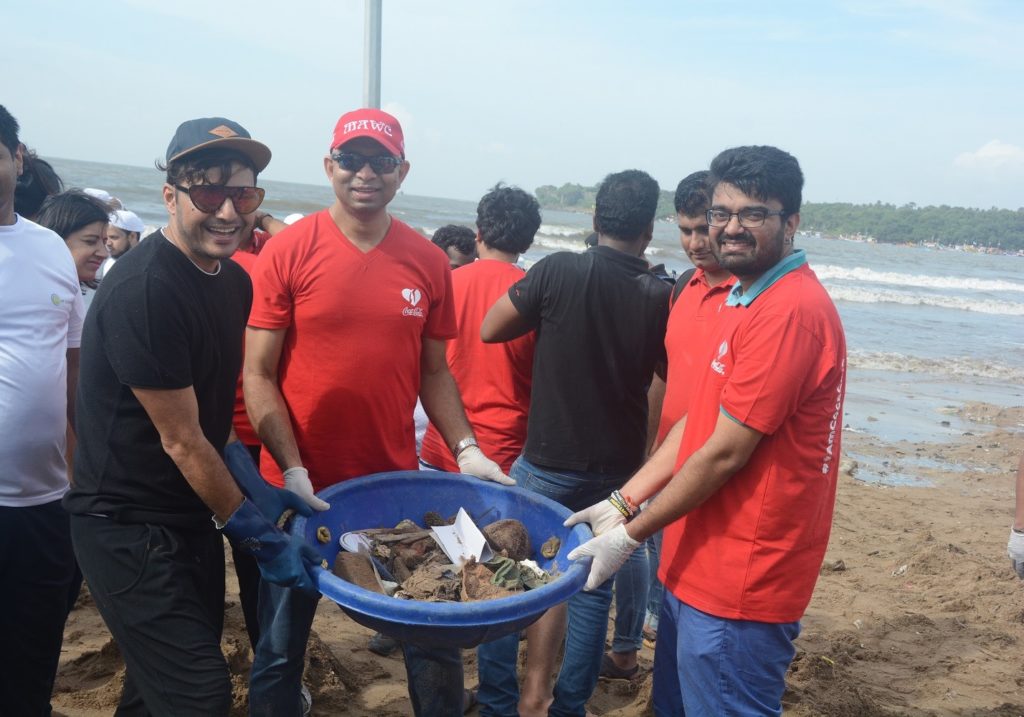
A year-long volunteer program has been launched to beat plastic pollution at Sanjay Gandhi National Park, Borivali and beaches of Mumbai by leading beverage firm Coca-Cola India.
Coca Cola India and AIESEC have teamed up with Afroz Shah-led ‘Date With Ocean Foundation’ for this program, an official statement said.
The yearlong volunteer program involves awareness creation, waste segregation, waste management program that will impact more than 15,000 people in 43 padas around Sanjay Gandhi National Park, and beaches in Mumbai.
Launching the project, Afroz Shah led 500 school children, AIESEC volunteers, Coca-Cola employees, citizen groups and key stakeholders in a beach clean drive at Versova beach.
Commenting on the volunteer program, Afroz Shah, said, “Waste management is a global environmental concern. To see a real change at the ground level, a collaborative and consistent effort is required to clear the waste out of our environment sustainably.
As part of this program, every week Afroz Shah along with volunteers will do their bit by:
Cleaning Danapaani beach, Versova Beach, SGNP Forest and River Mithi.
Train people living in the human-ocean conflict zone and on the banks of River Mithi to get Circular economy in their lives
Train people living in the human-animal conflict zone at Sanjay Gandhi national park, Borivali to get Circular economy in their lives
4Rs: Refuse, Reduce, Reuse & Recycle – Monetize plastic and no litter
Involve youth organization AIESEC, students and young leaders to contribute every week
Involve plastic industries in implementing Extended Producer’s Responsibility (EPR)
Shah said that the endeavour is to create a sense of belonging in the hearts and minds of people by engaging citizens, students and corporate though a volunteer program to beat plastic pollution as well as suggest ways for a circular economy.
“Plastic waste management is a key priority for India. At Coca-Cola, we care about the country and we aspire to help collect and recycle the equivalent of every bottle and can that we sell by 2030,” said Ishteyaque Amjad, Vice-President, Public Affairs, Communications and Sustainability, Coca-Cola India and South-West Asia.
AIESEC India President Devik Sodha said, “We place our confidence in youth as the key to unlock a better future and believe that it is the responsibility of the youth to actively engage in protecting the environment as well as bringing behavioural change in society.”
AIESEC is committed to support the Afroz Shah-led initiative by providing volunteer leadership to the community efforts and empower the next-gen community leaders, he added.
Ahead of Diwali, the Andhra Pradesh Government has given farmers good news by hiking the to the farmers Raithu Bharosa Scheme assistance to Rs 13500. Chief Minister Jagan Mohan Reddy announced this after a review meeting today
Ahead of Diwali, the Andhra Pradesh Government has given farmers good news by hiking the to the farmers Raithu Bharosa Scheme assistance to Rs 13500. Chief Minister Jagan Mohan Reddy announced this after a review meeting today. This amount will be transferred to the farmers in three instalments. The chief minister acceded to the request of the farmers who attended the review meeting. The budget of Rs 5510 crores for the scheme has already been released by the government.
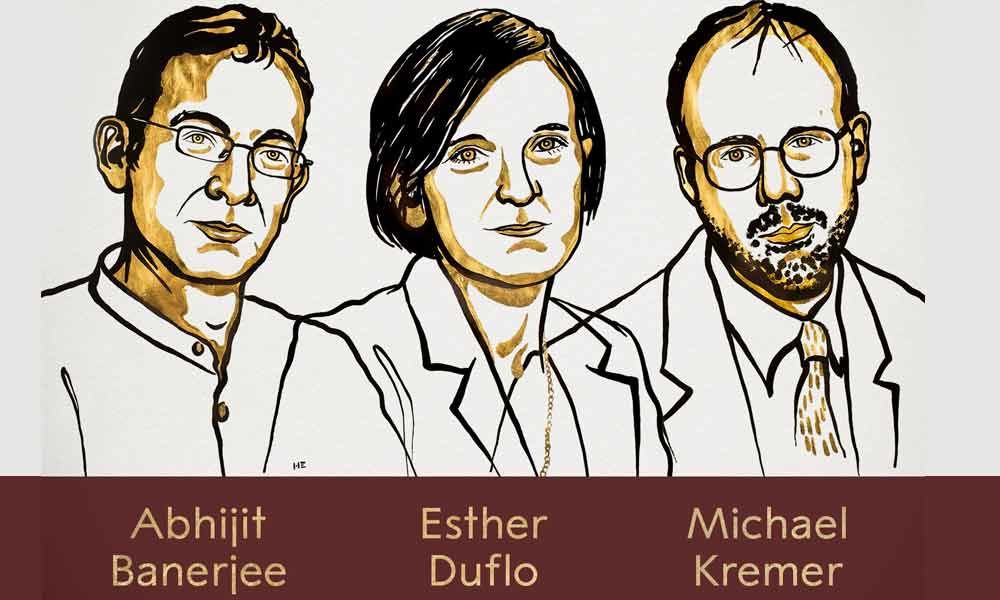
Indian-American Abhijit Banerjee, Esther Duflo and Michael Kremer jointly won the 2019 Nobel Economics Prize on Monday “for their experimental approach to alleviating global poverty.” “The research conducted by this year’s Laureates
Indian-American Abhijit Banerjee, Esther Duflo and Michael Kremer jointly won the 2019 Nobel Economics Prize on Monday “for their experimental approach to alleviating global poverty.” “The research conducted by this year’s Laureates has considerably improved our ability to fight global poverty. In just two decades, their new experiment-based approach has transformed development economics, which is now a flourishing field of research,” said the Nobel committee in a statement.
Banerjee, 58, was educated at the University of Calcutta, Jawaharlal Nehru University and Harvard University, where he received his Ph.D in 1988. He is currently the Ford Foundation International Professor of Economics at the Massachusetts Institute of Technology, according to his profile on the MIT website. In 2003, Banerjee founded the Abdul Latif Jameel Poverty Action Lab (J-PAL), along with Duflo and Sendhil Mullainathan, and he remains one of the lab’s directors. He also served on the UN Secretary-General’s High-level Panel of Eminent Persons on the Post-2015 Development Agenda.
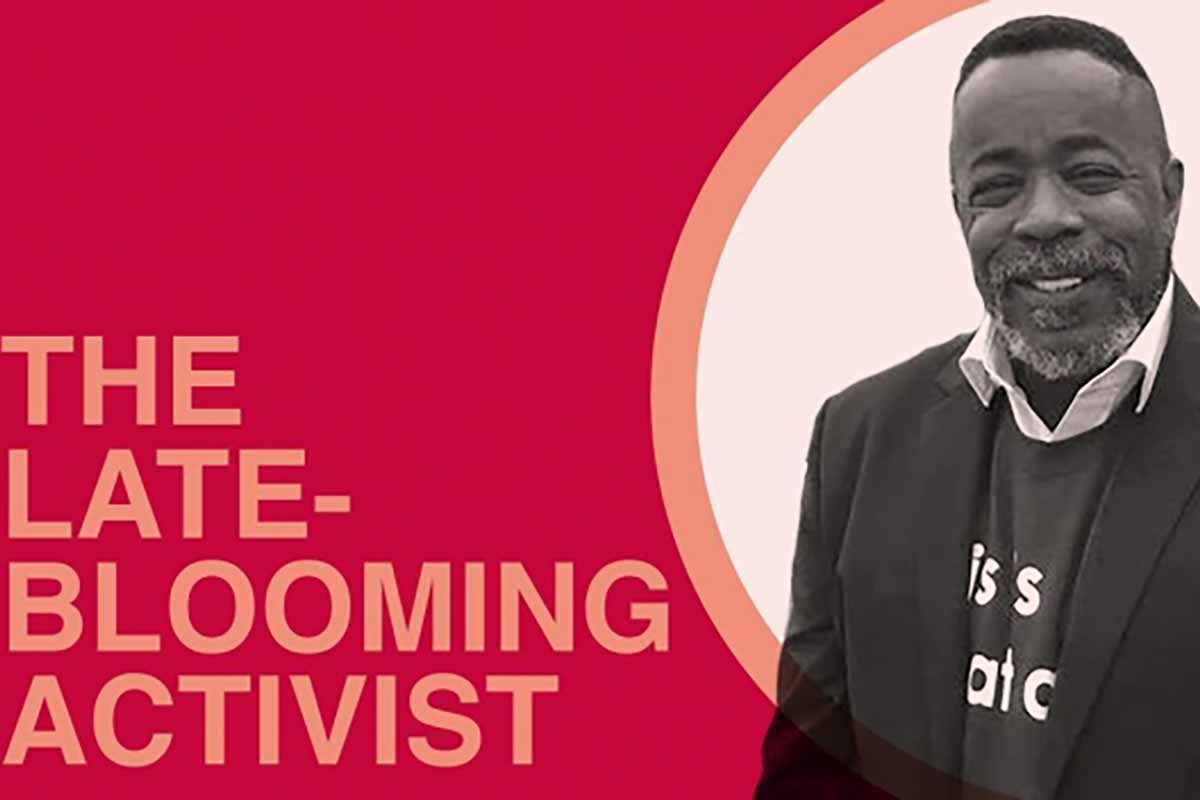
Malcolm Reid is based in Atlanta, Georgia and has been involved with HIV advocacy since 2014. He created THRIVE SS’s group for Black men living with HIV over the age of 50, Silver Lining Project, and works to help participants
Malcolm Reid is based in Atlanta, Georgia and has been involved with HIV advocacy since 2014. He created THRIVE SS’s group for Black men living with HIV over the age of 50, Silver Lining Project, and works to help participants grapple with aging, PTSD, loss, and stigma while training them in political advocacy. Malcolm is an avid thrill-seeker and rollercoaster enthusiast having ridden over 50 of the world’s fastest.
When did you find out you were HIV positive? How has your HIV status impacted your life?
When I was diagnosed in 1997, I was not surprised. The impact on my life, at first, was negligible. I went on with my life as if nothing was different. I took my pills and kept it moving. I met my current husband a year before and we were both diagnosed around the same time, so I had someone to support me and I, being a natural caretaker, put a lot of energy into taking care of him.
Years later, in 2014, I began to look at myself and my life. I realized how blessed I was. I also realized how selfish I had been. I knew that there were guys my age suffering in silence. Living a quiet existence, at home, alone. They were fearing disclosure, stigmatizing themselves. I realized that I was in a position to help. Even if it meant just being a sounding board to men my age or telling my story younger men.
I shared my desires with some friends. While on a cruise with a large group of SGL people, I spoke out in a workshop. I told my story and expressed my desire to get involved. My friends were responsive, and one led me to a supportive group, which I joined in August of 2015. That group later became THRIVE SS.
Where have you gotten support to manage your HIV treatment?
Because I have a job with good benefits, I have managed my own medical support. Since joining THRIVE SS as a volunteer and now employee, my support comes from my advocacy.
How long have you been involved in HIV advocacy?
I have been involved in HIV advocacy since 2015. After becoming a member of the THRIVE SS organization, I was able to create a group called “Mature Men of Color” to support black gay men living with HIV over the age of 50. Today that group is the Silver Lining Project and we are now working to implement the dream I had back in 2014 – programs geared to assist Black gay men living with HIV over the age of 50 to deal with aging, PTSD, loss, and stigma while helping them train others and become engaged in political advocacy.
Do you think there is an added stigma being a person from a racially marginalized community living with HIV, and if so, how do you handle it?
Yes, I do think there is added stigma being a person from a racially marginalized community living with HIV. While the African American community mostly votes liberal, African American people are very conservative in social and family circles. The church and family structure can be judgmental and unforgiving. I believe the best way to handle this is through communication and education. I try to take the fear and myth out of living with HIV. I am open and out about my status. I believe when people see me and my husband, out in the community, living, thriving, doing the work; they will understand that HIV is no longer a death sentence. It’s not just the rich famous athlete that can live an abundant life with HIV.
I also advocate for Undetectable = Untransmittable (U=U) because once people understand that people who are living with HIV receive the care they need, and achieve and maintain an undetectable viral load, they are unable to transmit HIV through sex and are, therefore, less likely to stigmatize us. From a policy and legal perspective, this will help us end the laws across the country that criminalize HIV.
Living in Georgia, we are affected by the refusal of our government leaders and representatives to expand Medicaid. This has led to hospitals and health centers closing in rural areas and has left thousands of people unable to afford their medications. Many people don’t have access and even if they did, they might not be able to afford care. U=U is only possible when there’s equal affordability to ensure access.
Do you feel that you face additional challenges in care as a member of a racially marginalized community living with HIV?
I have been blessed. I have a good job with great health insurance. Currently, I have no challenges accessing, affording and remaining in care. But I see the challenges my brothers face regularly with ADAP and other public health organizations and want to help them access the care they need.
How would you support someone who recently received a positive HIV diagnosis?
First, I would talk to them about their concerns and fears to learn where they are mentally. Are they self-stigmatized? Are they blaming themselves for their diagnoses? Then I would use the THRIVE SS model to connect them to care. We want to not only link them to care but make sure we address the social determinants of health such as housing and an ongoing support network.
If you could give your younger self one piece of advice, what would it be?
A good job and salary aren’t everything. Look around at your blessings and share them – get involved, early and often. Also, understand that everyone who is not achieving what you have achieved still has a story and value, and it’s up to us to lift them up.
What gives you hope?
Young advocates that are bringing new energy and creativity to advocacy give me hope. I’m also hopeful because of strategies like PrEP, which can help prevent the spread of HIV, and medications that keep those of us living with HIV undetectable and untransmittable.
Finance Minister Nirmala Sitharaman on Friday proposed a plan to create a Social Stock Exchange (SSE) under the regulatory ambit of Securities and Exchange Board of India (SEBI) that would allow the listing of social enterprises
Finance Minister Nirmala Sitharaman on Friday proposed a plan to create a Social Stock Exchange (SSE) under the regulatory ambit of Securities and Exchange Board of India (SEBI) that would allow the listing of social enterprises and voluntary organisations to help them raise funds for social welfare activities.
These organisation would be allowed to ‘list” in the same way the private firms list themselves on a stock market.
Presenting her maiden budget in Parliament, Sitharaman said, “It is time to take capital markets closer to the market and meet various social welfare objectives related to inclusive growth and financial inclusion.”
“I propose to initiate steps towards creating an electronic fund-raising platform, a social stock exchange, under SEBI for listing social enterprises and volunteer organisations,” she said.
The minister said that the exchange would help organisations to raise capital through equity, debt or a unit of mutual fund. Social stock exchanges make it easier for investors interesting in social entrepreneurship to find organisation to put money into, with a level of regulation about what the investment goes towards.
They already exist in countries like United Kingdom, Canada, Singapore, South Africa, Brazil, Jamaica and Kenya.
However, this announcement comes at a time when the Centre has been criticised for putting roadblocks on the path of socially inclined non-governmental organisations.
Eldis – Impact and Policy team at the Institute of Development Studies in the UK has come out with a study that discusses the role of business in the fight against HIV and AIDS with a particular focus on the private sector in India
Eldis – Impact and Policy team at the Institute of Development Studies in the UK has come out with a study that discusses the role of business in the fight against HIV and AIDS with a particular focus on the private sector in India. The report highlights particular interventions by Indian five companies ranging from advocacy and education to prevention and treatment.
Further, the report argues that because a large share of the country’s HIV-positive population are employed by Indian industry, businesses can gain from early decisive action to prevent HIV and AIDS. The paper also shows the advantages businesses bring to the fight, and how the Indian government supports companies involved in HIV and AIDS interventions.
In India both private and public sector companies are pursuing notable programs of HIV and AIDS awareness and prevention for employees and for local communities. The report highlights lessons from HIV and AIDS interventions by Indian businesses. These lessons include:
partnerships with local NGOs, State AIDS Control Societies, and other agencies have proved critical to the success of several programmes
companies have used several approaches to communicate HIV and AIDS messages to their workforce and local communities
programmes to support mobile target groups such as sex workers and their clients are important in preventing the spread of the virus
lack of government health facilities has created challenges in accessing medical and testing facilities
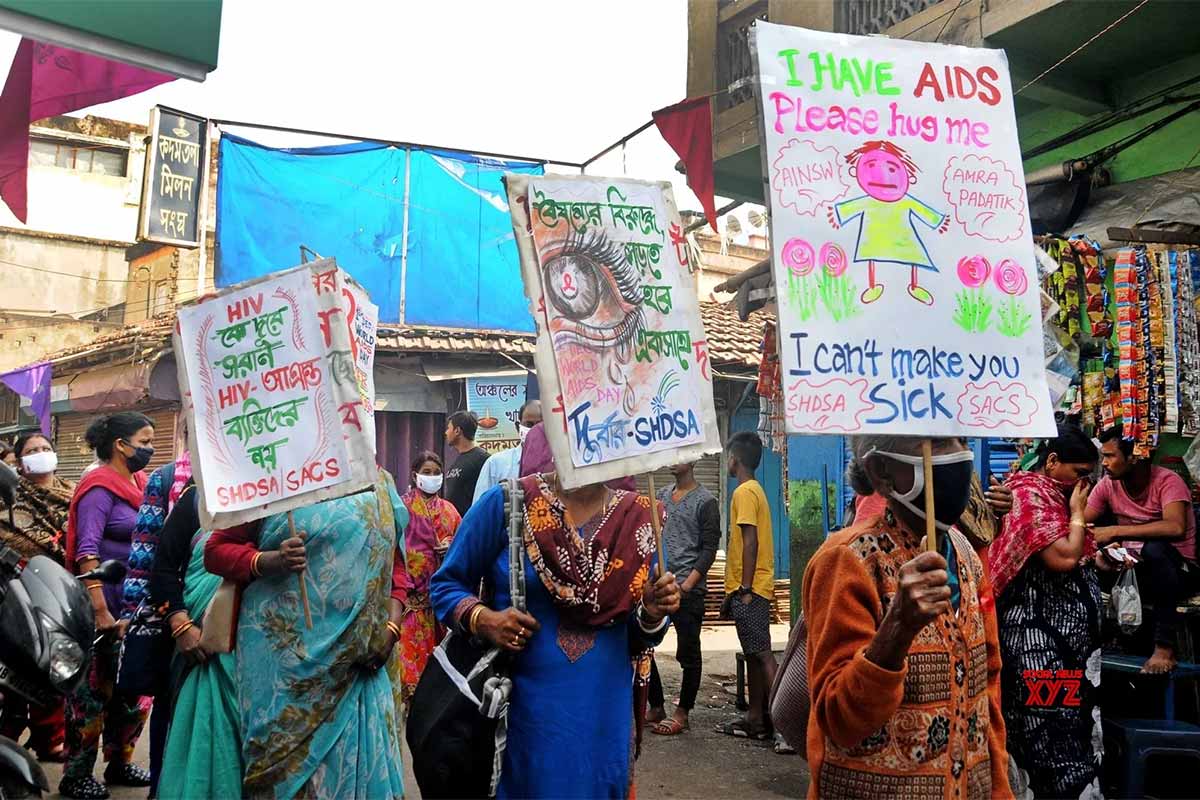
most programs have encountered resistance to HIV and AIDS messages because of the stigma attached to the epidemic and to topics related to sex
Experience in combating HIV and AIDS in India points to several key recommendations for private and public sector programmes:
taking early decisive action on prevention before the epidemic gets out of control will pay off for companies
improved monitoring and evaluation will help in planning and implementing programs, in identifying gaps, and in sustaining, scaling up, and expanding initiatives
continued financing is especially essential for treatment programs, which, once initiated, must not be interrupted.
A crucial legislation for ensuring equal rights to persons affected by HIV and AIDS in getting treatment, admission in educational institutions and jobs has come into force. The Ministry of Health has announced the implementation of the Human Immunodeficiency Virus (HIV)
A crucial legislation for ensuring equal rights to persons affected by HIV and AIDS in getting treatment, admission in educational institutions and jobs has come into force.
The Ministry of Health has announced the implementation of the Human Immunodeficiency Virus (HIV) and Acquired Immune Deficiency Syndrome (AIDS) Act through a gazette notification has been issued.
The Act, which received Presidential assent on April 20 last year, prohibits discrimination against such persons in accessing healthcare, getting jobs, renting accommodation, and in admission to public and private educational institutions.
The moves come after the Delhi High Court asked the Centre why it has not yet notified the law to prevent discrimination against HIV and AIDS patients despite the statute receiving Presidential assent in April last year.
Hearing a PIL that sought immediate notification of the legislation, a bench of Chief Justice Rajendra Menon and Justice C Hari Shankar had asked the health ministry, “You make a law and are not notifying it. Why?”. The matter was listed for hearing on November 26.
“In exercise of the powers conferred by sub-section 3 of section 1 of the Human Immunodeficiency Virus (HIV) and Acquired Immune Deficiency Syndrome (Prevention and Control) Act, 2017, the Central Government hereby appoints the 10th day of September, 2018, as the date on which the provisions of the said Act shall come into force,” the notification read.
According to the provisions of the Act, no HIV test, medical treatment or research will be conducted on a person without his informed consent and no person shall be compelled to disclose his HIV status for obtaining employment or services, except with his informed consent, and if required by a court order.
The legislation has provisions to safeguard the property rights of HIV positive people, he said, adding that every HIV infected or affected person below the age of 18 years has the right to reside in a shared household and enjoy the facilities of the household.
The act also prohibits any individual from publishing information or advocating feelings of hatred against HIV positive persons and those living with them.